Top>Ukuleles
Ukuleles
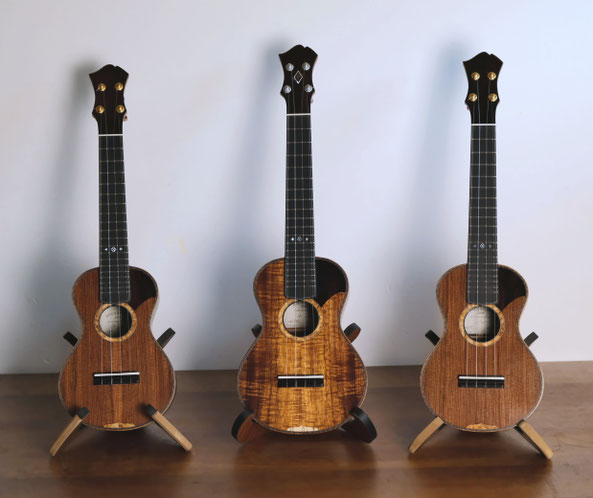
We are currently working on improving all our models to achieve a richer tone and superior fingering. We also plan to standardize all the decorations. Basically, we will offer two series depending on the value of the materials used. The standard series are "Authentic" which uses Western Red Cedar or Redwood for the soundboard and Rosewood for the side and back. The term "authentic" is used in the sense of "not false or imitative," as is the case with "real" and "actual," and also in the sense of "being true to one's own individuality, spirit, and character," as is the case with "true."
The top-of-the-line "Elite" series uses rare and high-quality woods such as Master Grade Hawaiian Koa and Brazilian Rosewood. The wood used for decoration will be of Japanese origin and of exceptional quality. An original inlay featuring a "Jingu amulet"(神宮札) will be placed at the 12th fret of the fretboard.
A long time ago, I read a thick book on how to make classical guitars. Later, I also read Irving Somogyi's English version on acoustic guitar making. Then, in 2004, I spent two years studying actual guitar making techniques at a musical instrument making vocational school in Nagoya. Since then, I've been completely captivated by the charm of ukuleles and have made nothing else. Structurally, they look the same in that the neck is joined to the body and strings are attached, but the fundamental methods and philosophies for making a guitar and a ukulele sound beautiful are different.
In the 19th century, Antonio Torres' experiment of attaching a spruce top to paper sides and back demonstrated that the influence of the top on the sound was far greater than that of the sides and back. A guitar produces sound by stretching a light membrane over a solid body, similar to the principle of a drum. However, a ukulele, with its much smaller body, requires all the boards that make up the body to be thin. It became clear at some point that both the top and sides and back needed to be constructed as if they were all vibrating membranes. To put it simply, the answer lies in the form that Martin & Co. perfected after years of practice in the early 20th century. I painstakingly traced that answer myself and arrived at the same conclusion. In fact, when Martin & Co. first started making ukuleles in the early 1900s, they had a guitar-like construction with hard sides and back and spruce tops, and customers returned them saying they couldn't sell them. After that, they continued to research and created the form that continues to this day. I think there is a lot that individual makers can learn from great manufacturers.
But the interesting part is what happens next. While it's true that you need to learn the basics, that alone isn't enough to develop your own individuality as a maker. I'm Japanese. Therefore, even with ukuleles made from exotic woods, I want to create a Japanese atmosphere that evokes a sense of Japan. This was the central theme of this final model change.
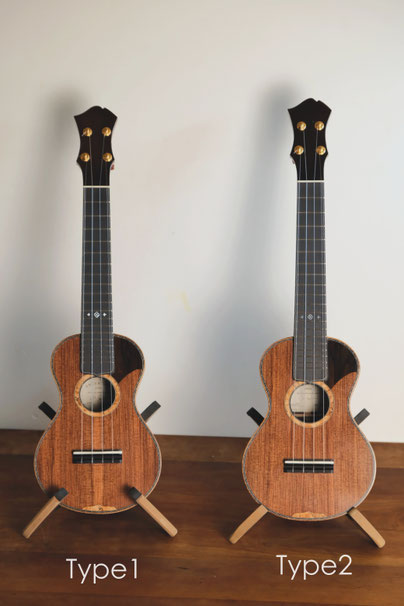
Body size comparison
Type2 is slightly bigger than Type1. So, each has different sound characteristics. Type 1 is characterized by tight treble and punchy midrange, while Type 2 produces a more balanced sound overall. The creator myself is a person who deeply loves soprano, so my dedication and affection for these two models are extraordinary. While the standard string length for a soprano saxophone is around 345mm, the Type 1 uses a slightly longer 360mm string length, which is 15mm longer. This makes playing in the higher positions much easier. Nevertheless, the feel of actually playing it is still exactly like a soprano ukulele. Type 2 ukuleles are positioned between soprano and concert ukuleles. They have a noticeably louder sound than sopranos, and a string length of 375mm that is noticeably less strenuous on the fingers than concert ukuleles. Owners of Type 1 often become interested in Type 2 and order a second one. I think that's probably the right decision.
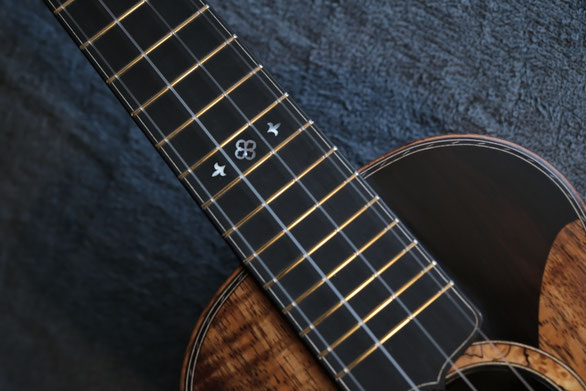
Jingu amulet [神宮札] inlay
Every year, I visit Ise Grand Shrine and Izumo Grand Shrine with my family. We go there to pray for good health and peace throughout the year. The shrines are the head shrines of Japan's ancient gods and symbols of Japan. I inlay them into the center of the fretboard of the ukuleles I make.
Authentic Models
Type1
soprano
- scale /360mm
- joint/14
- fret/19end
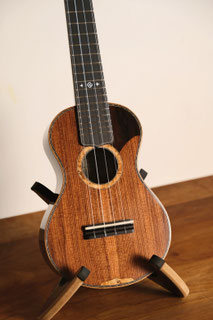
This ukulele has a sinker redwood top. The sides and back are made of rosewood. The rosette, bottom ornament, and binding are made of spalted horse chestnut. The fingerboard is made of ebony from Cameloon, with a original "shrine amulet" inlay at the 12th fret.
The scale length is slightly longer than authentic soprano, 360mm. It makes you feel more comfortable to play at high fret
code.
type2
SOPRANO LONG
- scale/375mm
- joint/14
- fret/19end

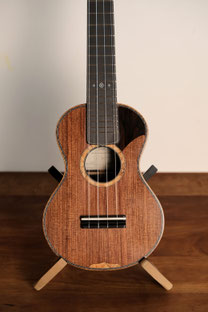
This ukulele has a sinker redwood top. The sides and back are made of rosewood. The rosette, bottom ornament, and binding are made of spalted horse chestnut. The fingerboard is made of ebony from Cameloon, with a original "shrine amulet" inlay at the 12th fret. It's a size somewhere between concert and soprano, 375mm. In my opinion, this Type2 is the most favorite shape, which gives me good vibes and comfort touch.
type3
CONCERT
- scale/392mm
- joint/14
- fret/19end

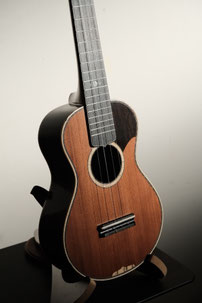
This ukulele has a sinker redwood top. The sides and back are made of rosewood. The rosette, bottom ornament, and binding are made of spalted horse chestnut. The fingerboard is made of ebony from Cameloon, with an original "shrine amulet" inlay at the 12th fret. It's an authentic concert size, but the scale length is slightly longer, 392mm. It makes sounds deeper than others. You can also feel more rich tone and smooth fingerings during play with this ukulele.
type4
tenor
- scale /17.5'
- joint/14
- fret/19end
elite models
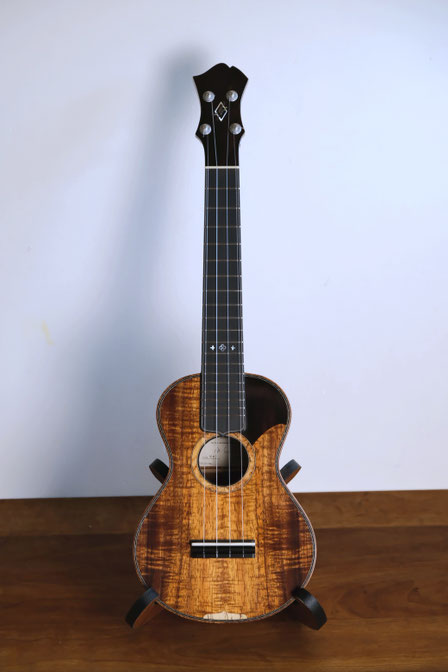
The "Elite" model is part of a series that luxuriously utilizes rare, high-grade woods.The name "elite" comes from the Latin word "eligere" (to select). The combination of "e" (out) and "ligere" (to choose) signifies "the chosen one." This name was chosen to reflect the fact that our ukuleles are made with high-quality and exceptional materials.
The headstock of the Elite model features a diamond inlay in the center. The headstock veneer and the built-in inlays on the body are made of Brazilian rosewood. This luxurious series will satisfy the owner's desire for ownership.
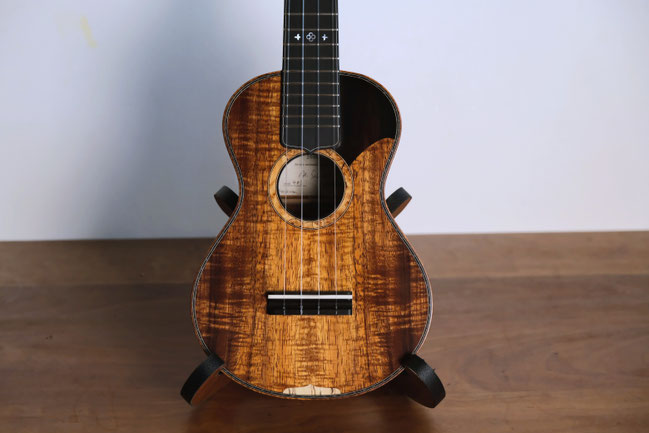
Master grade Hawaiian Koa

Diamond inlay
6ukes comparison [by chris]

This is an interesting experiment where he compared six soprano ukuleles, all with the same strings and high G tuning. He played six ukuleles in various styles: one belonging to Chris's wife, one given to him by a friend, one made by a British builder "Wonder Comer", one by an Italian builder"Marco Todeschini" and two Ancestor's. The Wonder Comer ukuleles have a sound that is mainly suited to the musical style of George Formby from the 1920s, while the Ancestor's sound that is suited to songs that mainly feature chord solos in the Ohta-san style. Ancestor's have a clear chord sound, so if you listen carefully, you might be able to tell which ukulele it is. Please give it a try.